
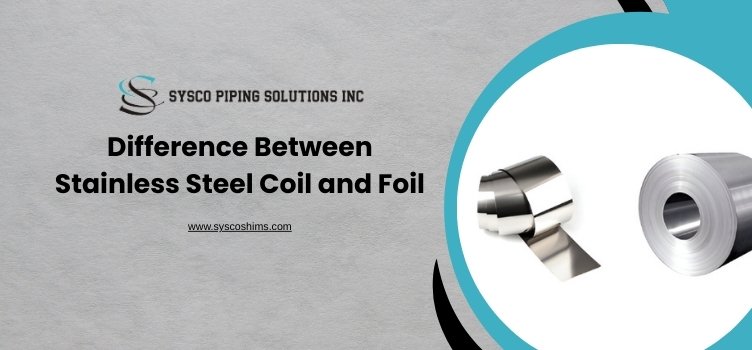
Understanding the Key Variations Between Stainless Steel Coil and Foil
The stainless steel product world is expansive; however, two types can be confusing: stainless steel coil and stainless steel foil. These materials find extensive application in the manufacturing industry, construction industry, electronics, HVAC, and precision-based industries. Considering the Difference Between Stainless Steel Coil and Foil, it is evident that both of them have their applications, benefits, as well as engineering uses. Just as Why Stainless Steel Coil is Essential in Manufacturing has demonstrated the importance of coils in any large industrial setting, the exploration of these differences aims to enable buyers, contractors, architects, and project leaders to make more informed procurement decisions. This guide disaggregates the differences in coils and foils in terms of their thickness, manufacturing process, mechanical properties, cost aspects, as well as optimal use.
What Is Stainless Steel Coil?
A stainless steel coil is a rolled and continuous strip of stainless steel that is widely used in heavy-duty industries. It is strong, resistant to corrosion, and flexible.
Key Features:
- It can be found in a large selection of thicknesses.
- Applicable to the structural and load-bearing.
- The industrial process has high durability.
Common Applications
- Construction and roofing.
- Automotive body parts.
- Storage tanks and vessels.
- Heat exchangers.
- Production of pipes and tubes.
If you’re evaluating which coil type fits your project, you may also find value in our detailed resource on Understanding Stainless Steel Coils: A Breakdown of Grades and Uses. Additionally, if you’re comparing coil with narrower flat products, the Difference Between Stainless Steel Coil and Strip clarifies the distinctions clearly.
What Is Stainless Steel Foil?
Stainless steel foil is a super-thin sheet that is a result of precision rolling. It is much thinner than a coil and is applied in situations that demand fineness.
Key Features
- Very thin (frequently less than 0.2 mm) thickness.
- Great ability to flex and conform.
- Applicable to thermal, chemical, as well as electronic uses.
Common Applications
- Battery components.
- Electronic shielding.
- Medical instruments.
- Aerospace insulation.
- Precision tools and gaskets.
Stainless Steel Coil vs Foil: What Makes Them Different?
To know the distinction between the stainless steel coil and foil, it is necessary to compare a number of points.
Thickness and Difference of Manufacturing
This stands out as the apparent difference between stainless steel coil and foil.
Coils
- It is produced in heavier gauges.
- Demand powerful rolling mills.
- Enhanced to have tensile strength.
Foils
- Micro-rolling is the method of production.
- Extremely lightweight.
- Constructed to be accurate and perfectly true.
Mechanical Properties and Strength Comparison
Both are strong materials, though not equally.
- Stainless steel coil is of excellent strength, hence suitable as a structural, load-bearing, and industrial wire.
- Stainless steel foil is flexible, thermal-resistant, which can be used in delicate operations or high-temperature operations.
Applications in the Construction and Industrial Sectors
The coils and foils are applied to various projects differently by contractors, builders, architects, and engineering teams as per the requirements of the project.
Coils Are Best For:
- Large architectural panels.
- Industrial fabrication.
- Pressure vessels.
- HVAC ducting.
Foils Are Best For:
- Electrical components.
- Thermal insulation.
- Heat-resistant layers.
- Micro-engineered parts.
Cost Difference Between Stainless Steel Coil and Foil
The price is differentiated by the complexity of production and the use of materials.
- Coils: Less precise manufacturing, but more material input higher input of material in coils, hence less expensive, cost-efficient in large quantities.
- Foils: Special tolerances and precision rolling raise the price per kg.
Advantages of Stainless Steel Coil
- Suitable for large-scale production.
- Corrosion and wear-resistant.
- Applicable in many industries.
- Cost-effective in bulk.
Advantages of Stainless Steel Foil
- Lightweight and flexible.
- Great accuracy of delicate parts.
- Excellent heat resistance.
- Appropriate for small and complex systems.
Quick Comparison Table
| Feature | Stainless Steel Coil | Stainless Steel Foil |
|---|---|---|
| Thickness | Thick | Ultra-thin |
| Strength | High | Moderate |
| Flexibility | Low | High |
| Applications | Industrial & construction | Electronics & precision |
| Cost | Bulk-friendly | Higher precision cost |
Conclusion
To conclude, we successfully studied the significant distinctions between the stainless steel coil and foil, such as the thickness, strength, manufacturing differences, areas of use, and costs. The materials are used in different applications, coils are best in the heavy industrial and building projects, and foil is good in the precision-based industries such as electronics, medical, and the air industry. These differences will enable professionals to select the appropriate stainless steel form to use in a project.
FAQs
Q1. What are the primary distinctions between the stainless steel coil and foil used in industry?
The main distinction is made on thickness -coils are thicker and can be used in building work, whilst foils are ultra-thin and intended to be used where greater precision and heat resistance are needed.
Q2. What is better when building constructions: stainless steel coil or foil?
Stainless steel coil is more preferable to use in construction because it is stronger, has a higher load-bearing capacity, and is durable.
Q3. Does it mention that the foil is heat-resistant in high-temperature usage of stainless steel?
Well, yes, stainless steel foil is remarkably effective at high levels of temperatures and is therefore suitable for insulation, aerospace, and thermal parts.
Reach out today to get expert guidance and high-quality supplies for Stainless Steel foil and Stainless Steel coil. Contact us at: export@syscoshims.com