
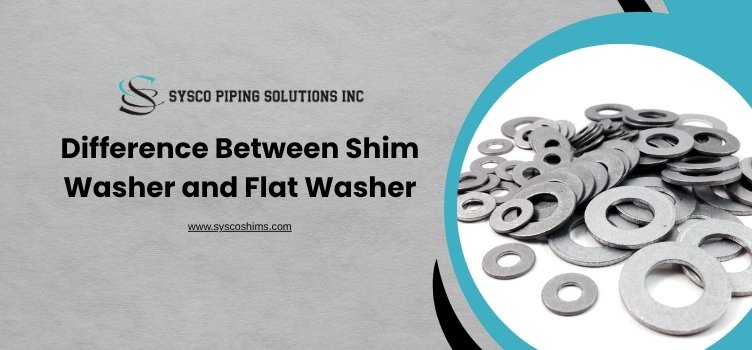
What are a shim washer and a flat washer?
You are at the right place. The two washers are similar to one another in their looks, though they are not employed in much the same way, either in industry or in a mechanical sense. The difference between Shim Washer and Flat Washer is important to understand because choosing the wrong one may affect performance. Regardless of what you do, whether you are an engineer, a manufacturer, or a technician, knowledge of the correct type of washer to use can have a severe effect on the quality, stability, and functionality of the assemblies.
What is a shim washer?
A shim washer is a thin part that is finely machined and is used to seal small holes as well as to rework tolerances and acquire accurate spacing between machine parts. It is widely applicable in cars, airplanes, heavy equipment, and manufacturing sectors.
Key Features of Shim Washers
- They come in different accurate cuts in terms of thickness to the extent of being the same as 0.05 mm.
- These are manufactured using stainless steel, copper, and brass.
- Used in correct positioning and regulated the distance.
- Resists wear, corrosion, and vibration.
To describe this in simple terms, shim washers are compensatory factors employed in order to provide the dimensional accuracy and alignment of mechanical parts.
What is a Flat Washer?
A flat washer is a thin, flat, circular plate that has a hole in the middle to distribute the load of a threaded fastener, e.g. screw or a bolt. It also removes surface damage and ensures stress homogeneity.
Key Features of Flat Washers
- Typically, either stainless, carbon, or nylon.
- Bolts or nuts have their heads attached to reduce friction.
- Protects against damage to surfaces by fasteners.
- Help does not compromise the relationship and does not slacken.
Flat washers are available in almost all kinds of assembly, in regards to household products and heavy machinery.
Comparison between Shim Washer and Flat Washer.
It is worth considering a closer glance at the difference between a shim washer and a flat one, in the areas of design, functionality, and usage.
| Parameter | Shim Washer | Flat Washer |
| Purpose | Utilized in making accurate alignment, spacing, and adjustment. | Applied in the distribution of loads and protection of the surface. |
| Thickness | Really slim and comes in micro-measurements. | Monolithic, which is not generally a customizable feature. |
| Precision | Tolerance correction of high precision. | Moderate level of general use. |
| Applications | Machinery, tool setups, engineering, and automotive. | Construction, mechanical fixing up, and furniture. |
| Cost | The slight is because of the manufacturing accuracy. | Cheap and easily accessible. |
| Customization | Notched in tailor-made sizes and materials. | Usually standardized sizes |
Their significance is similar, yet it is clear that in terms of mechanical efficiency and life span, it is better to learn which one fits your requirements.
When to Use a Shim Washer?
In occasions where accurate alignment and spacing are required, the shim washers are applied. You are to use a shim washer:
- Components must be flattened or tightened.
- In devices that require the reduction of vibration and wear.
- Where it is needed to adjust or calibrate the high-frequency.
- During the manufacture of precision tools or motors.
An example is in gear assembly, whereby shim washers are employed to ensure that the gears and shafts fit perfectly, so as to make sure that there is no inefficiency in the operations.
When selecting a shim washer or a flat washer?
- Precision: In the micro-level precision situations, then shim washers are used.
- Budget: The use of flat washers is cheaper and suitable for simple fastening.
- Application Type: Shim washers can be applied most in alignment and tolerance correction cases, whereas flat washers are used in load distribution cases.
- Material Requirements: They are both constructed of stainless steel and brass, based on the needs of corrosion resistance.
The best that can be applied is the shim washers in precision engineering. Flat washers are sufficient in the instance of the overall mechanical fastening.
Resource of Shim and Flat Washers.
Both washing machines can be used based on any material, depending on the environment and loading requirements:
- Stainless Steel: To avoid corrosion and be tough.
- Brass: To offer conductivity of electricity as well as a pleasant finish.
- Carbon Steel: It is intended to be used in heavy work.
- Aluminum: No corrosion, light.
The manufacturers, e.g., Sysco Shims, a well-known shim manufacturer in India, offer a range of precision-engineered washers that can be applied to industries and engineering.
Shim Washers and Flat Washers Screens.
Shim Washer Applications
- Gearboxes and motor vehicle transmissions.
- Balancing industrial equipment.
- Aerospace components
- Tool and die setups
Flat Washer Applications
- Assemblies, structural and construction.
- Assemblies, structural and construction.
- Furniture fittings
- General mechanical joints
Conclusion
This would help make better design and assembly decisions because you would have an idea of the distinction between a shim washer and a flat washer. Mechanical engineering requires two constituents, though they are used differently depending on the application of the same, in terms of power and accuracy.
And when you have to find a good shim manufacturer in India, or even when you are trying to find the best flat washers, you may consider the products of the reputed supplier, such as Sysco Shims, specializing in shims and flat washers, which are carefully designed to fit in any industry in the entire world.