
Precut Shims vs Custom Shims: The Short Answer
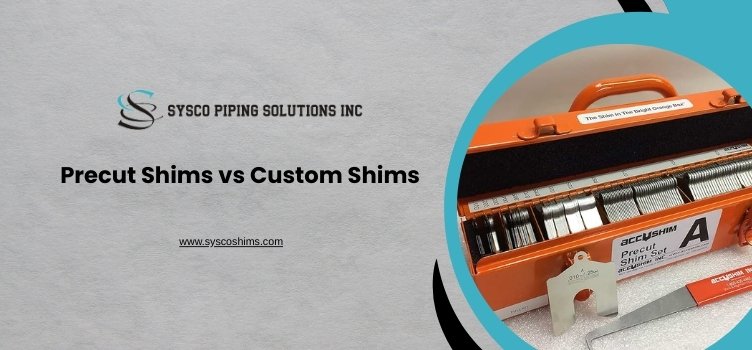
Precut shims vs custom shims comes down to shape, size and lead time. Precut shims are ready-made in standard sizes and thicknesses, usually marked and supplied in kits, so you can align a motor or pump the same day. Custom shims are cut to your component’s footprint or made in a special thickness or material, so they take longer but fit exactly.
Neither is more accurate by default. Both can be made as precision shims, so the right choice depends on the equipment, the loads and how fast you need the part. This guide is about metal shims for machinery alignment, not the wooden wedges used in carpentry.
Key takeaways
- Precut shims come in standard sizes and thicknesses. They ship from stock and cost less.
- Custom shims are cut to a component’s profile or made in special thicknesses and materials.
- The difference is shape, size and lead time, not accuracy. Both can be precision parts.
- Use precut shims for routine alignment of motors, pumps and couplings. Use custom shims when standard sizes do not fit the footprint or the load.
- Use as few shims as possible, and confirm the actual thickness with a micrometer.
What Are Precut Shims?
Precut shims are ready-made shims in standard sizes and thicknesses. Many are slotted or U-cut, so they slide under a bolted foot without removing the bolt. Each shim is usually marked with its thickness, and they are sold individually or in a pre-cut shim kit box.
Stainless steel is the usual material, and brass and copper are also common. Browse our precut shims, ready cut shims and U cut shims, or see how they are used in eliminating shaft misalignment with precision pre-cut shims.
Benefits of Precut Shims
- Available immediately, with no wait for fabrication
- Lower cost for standard equipment
- Quick, repeatable adjustments during alignment
- A kit covers the common thicknesses in one case
Limitations of Precut Shims
- Limited to the standard sizes and thicknesses in the range
- Unusual footprints, bolt patterns or special materials may not fit
What Are Custom Shims?
Custom shims are cut to your drawing: the exact outline, hole or slot pattern, thickness and material. They suit equipment with unusual footprints, tight tolerances or demanding service. Common materials include stainless steel shims, brass shims and copper shims.
Benefits of Custom Shims
- Fit the exact footprint and bolt pattern
- Made in the thickness and material the job needs
- Suitable for heavy-duty, high-load or corrosive service
Limitations of Custom Shims
- Higher cost per piece
- Longer lead time, because they are made to order
Precut Shims vs Custom Shims: A Detailed Comparison
This table shows how precut shims vs custom shims compare on the points that matter most when you specify shims.
| Feature | Precut Shims | Custom Shims |
|---|---|---|
| Shape and size | Standard outlines, often slotted or U-cut | Cut to your component’s profile |
| Thickness | Standard steps, marked on each shim | Any thickness the material allows |
| Accuracy | Set by the manufacturer’s tolerance on each thickness | Set by the tolerance you specify |
| Material options | Mainly stainless steel, plus brass and copper | Stainless steel (304, 316), brass, copper and others |
| Cost | Lower | Higher |
| Lead time | Immediate from stock | Requires production time |
| Best for | Routine alignment of motors, pumps and gearboxes | Unusual footprints, special loads or materials |
When to Use Shims in Machinery Alignment
Shims fill the gap between a machine foot and its base, so the shaft sits level and in line with the driven equipment. Wood and plastic wedges suit carpentry, but they compress under load and are not suitable for machinery.
Common Applications
- Motors and pumps
- Gearboxes and couplings, including a coupling shim set
- Valve and actuator mounting
- Vehicle and heavy equipment alignment
- Base plates and structural supports, as covered in why shims are critical in heavy engineering
Example: How to Shim a Motor Foot
- Check each foot for soft foot and measure the gap.
- Choose the thinnest stack that fills the gap, using as few shims as possible.
- Slide the shims under each foot and tighten the bolts to specification.
- Re-check alignment with a dial indicator or laser tool, adjust, and repeat.
How to Choose Between Precut and Custom Shims
- Footprint and bolt pattern: if a standard slotted or U-cut shim fits, precut shims will work.
- Thickness: a kit covers the common steps. Choose custom for odd values or very fine steps.
- Load and environment: for heavy load, corrosion or heat, specify the material and grade.
- Tolerance: confirm the thickness tolerance, and measure with a micrometer instead of trusting the marking.
- Lead time and volume: precut for urgent jobs, custom for repeat or special orders.
Use as few shims as possible. A few thicker shims are more stable than a tall stack of thin ones, which can compress and shift. For a wider overview of shim types and grades, read what shims are, their types, grades and applications.
Why Choose Custom Metal Shims for Industrial Projects?
Custom metal shims make sense when standard sizes cannot meet the job. Specifying the material, thickness and outline lets you control:
- Corrosion resistance, through the choice of stainless steel, brass or copper
- Load-bearing capacity, through the material grade and thickness
- Exact thickness for critical alignment
- Repeatable parts for regular orders
To compare materials, see brass shim sheets vs stainless steel shims.
Are Stainless Steel Precut Shims a Good Middle Ground?
Stainless steel precut shims combine stock availability with the corrosion resistance and durability that plastic and wood cannot match. They are a practical choice for rotating equipment, including outdoors and in semi-industrial plants. When the footprint or tolerance falls outside the standard range, move to custom.
How to Order Custom Shims
To get an accurate quote for custom stainless steel shims or other custom shims, send:
- A drawing or dimensions, including the outline and any holes or slots
- Thickness and the tolerance you need
- Material and grade, such as stainless steel 304 or stainless steel 316
- Quantity and delivery date
Conclusion
The choice between precut shims vs custom shims follows the job. Precut shims are quick and cost-efficient for standard equipment, and custom shims fit unusual footprints, loads or materials exactly. Knowing when to use shims and which type to specify helps you get the alignment right the first time. Browse our full shims range to see the options.
FAQs
Q1. When should I choose custom shims over precut shims?
Choose custom shims when a standard slotted or U-cut shim does not fit the footprint, when you need an unusual thickness or material, or when the load or environment calls for a specified grade.
Q2. Are stainless steel precut shims suitable for outdoor use?
Yes. Stainless steel resists corrosion, so precut stainless steel shims work in outdoor and semi-industrial settings. For marine or chemical exposure, consider grade 316.
Q3. Are precut shims less accurate than custom shims?
Not necessarily. Accuracy depends on the manufacturer’s thickness tolerance, not on whether a shim is precut or custom. Check the tolerance, and verify the thickness with a micrometer.
Q4. How many shims can I stack under a machine foot?
Use as few as possible. Fewer, thicker shims are more stable than a tall stack of thin ones, because thin shims can compress and shift.
Looking for precut shims or custom stainless steel shims for your next job? Contact us or email export@syscoshims.com.